





AmScope PS25 Prepared Microscope Slide Set for Basic Biological Science Education, 25 Slides, Includes Fitted Wooden Case Brown : Toys & Games
- Category: Microscope Sample Slides
- Store: AmScope
Share on:
Description
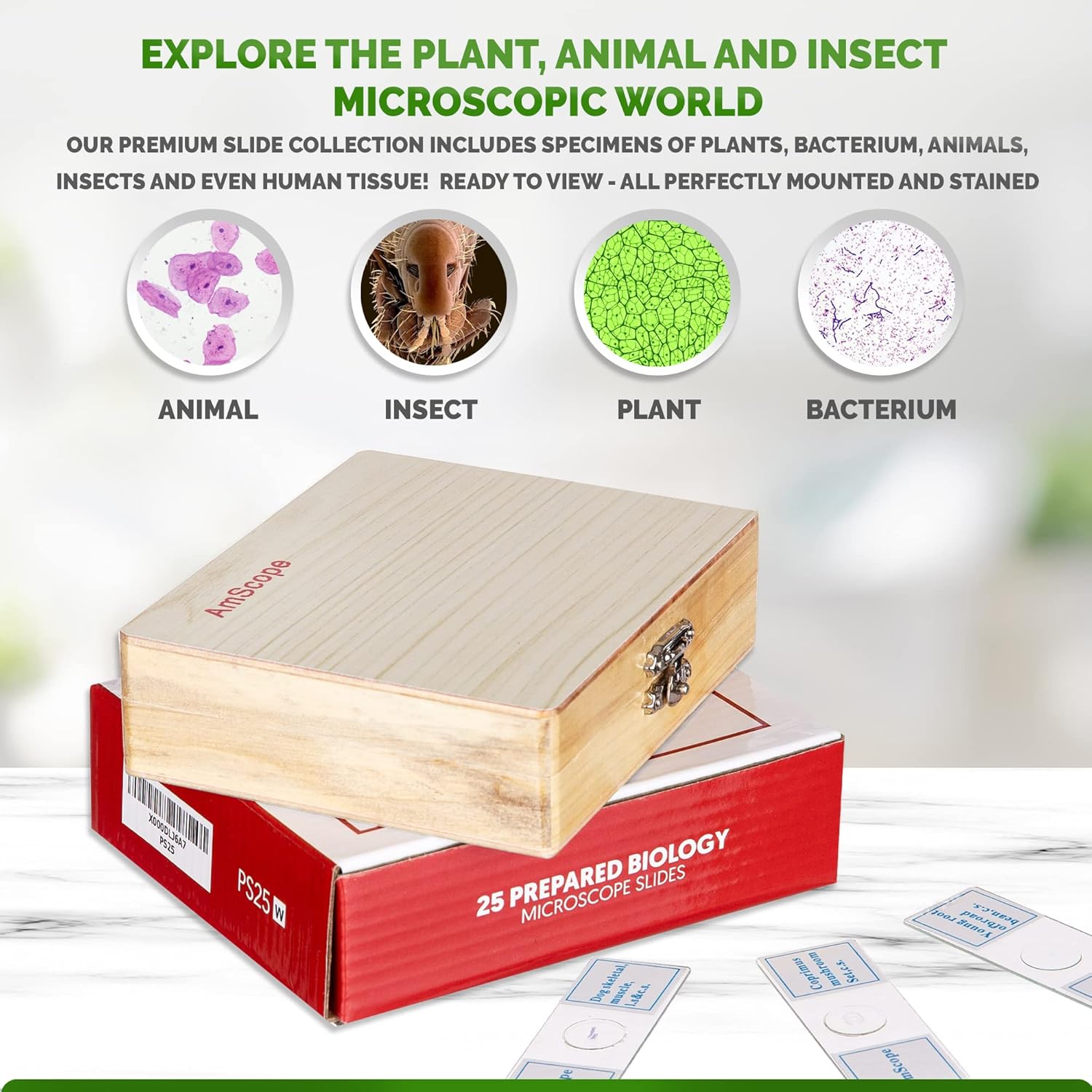
The AmScope PS25 microscope slide set includes 25 prepared slides of a variety of specimens including plants, insects, and animal tissues used in basic biology education. The samples are preserved in cedar wood oil and sealed with a coverslip to preserve specimens and prevent contamination. Labeling on each slide identifies specimens. Slides are composed of optical glass for clear viewing and are 3 x 1 x 0.4 inches/75 x 25 x 1mm (H x W x D, where H is height, the vertical distance from the lowest to highest point; W is width, the horizontal distance from left to right; D is depth, the horizontal distance from front to back.) The set comes in a fitted wooden case to prevent breakage and ease handling.Slide specimens include coprimus mushroom (cross section), dense connective tissue (section), dog cardiac muscle (longitudinal section), dog esophagus (cross section), dog skeletal muscle (longitudinal section and cross section), dog stomach (section), honeybee worker leg-composite (whole mount), house bee mouth parts (whole mount), human blood (smear), hydra (longitudinal section), Hydrilla verticillata leaf (whole mount), Lilium anther (cross section), Lilium ovary (cross section), nymphaea of apustio stem (cross section), onion epidermis (whole mount), pig motor nerve (section mount), pine leaf (cross section), pine stem (cross section), pumpkin stem (cross section), rabbit spinal cord (cross section), rabbit testis (section), sunflower stem (cross section), Tilia stem (cross section), young root of broad bean (cross section), Zea stem (cross section). Microscopes are instruments used to enhance the resolution of an object or image. Types include compound, stereo, or digital. Compound microscopes use a compound optical system with an objective lens and an eyepiece. Stereo microscopes show object depth in a three-dimensional image. Digital microscopes are used to display an image on a monitor, rather than looking through a lens. Microscopes can have monocular (one), binocular (two), or trinocular (three) eyepieces, with varying magnification abilities. Magnification ability refers to the size of an image. Resolution, also known as resolvant power, refers to the clarity of the image. The interaction between field of view (FOV), numerical aperture (NA), and working distance (WD) determines resolution. Microscopes can control magnification through a fixed focus, or through a range of adjustments. They can also utilize LED, fluorescent, and mirror light sources to help control viewing capabilities. Microscopes are widely used in education, lab research, biology, metallurgy, engineering, chemistry, manufacturing, and in the medical, forensic science, and veterinary industries.United Scope manufactures microscopy equipment and accessories under the brand name AmScope. The company, founded in 1996, is headquartered in Irvine, CA. This is a 25 piece prepared microscope slide set of various plants, insects and animal tissues. The slides are coverslipped and preserved in cedar wood oil. They are premium, accurately stained and machine cleaned slides that will give a sharp image. All slides are carefully labeled for easy reference and are arranged in a wooden box. This is a curated, educational selection of 25 prepared slides for students. This slide set is excellent for educational use and is perfect for all levels of study including home school programs, grade school science, and high school biology. 25pc prepared slides of plants, insects and animal tissues Dimensions: 1" x 3" (25mm x 75mm) Sample name is marked on each slide. One wooden box for slide storage included Manufactured under ISO 9001 quality control standard Explore Microscope Sample Specimens of: Animals Insects Plants Bacterium Frosted, Rounded Edges Ensure Safety with no Sharp Edges. Slides are Kid-Friendly and won't Scratch in Sleek Storage case Design Features: Easily store and identify samples with the guide inside the lid Safely store slides from damage and contamination To calculate the overall star rating and percentage breakdown by star, we don’t use a simple average. Instead, our system considers things like how recent a review is and if the reviewer bought the item on Amazon. It also analyzed reviews to verify trustworthiness.
Product Overview
We Recommend