
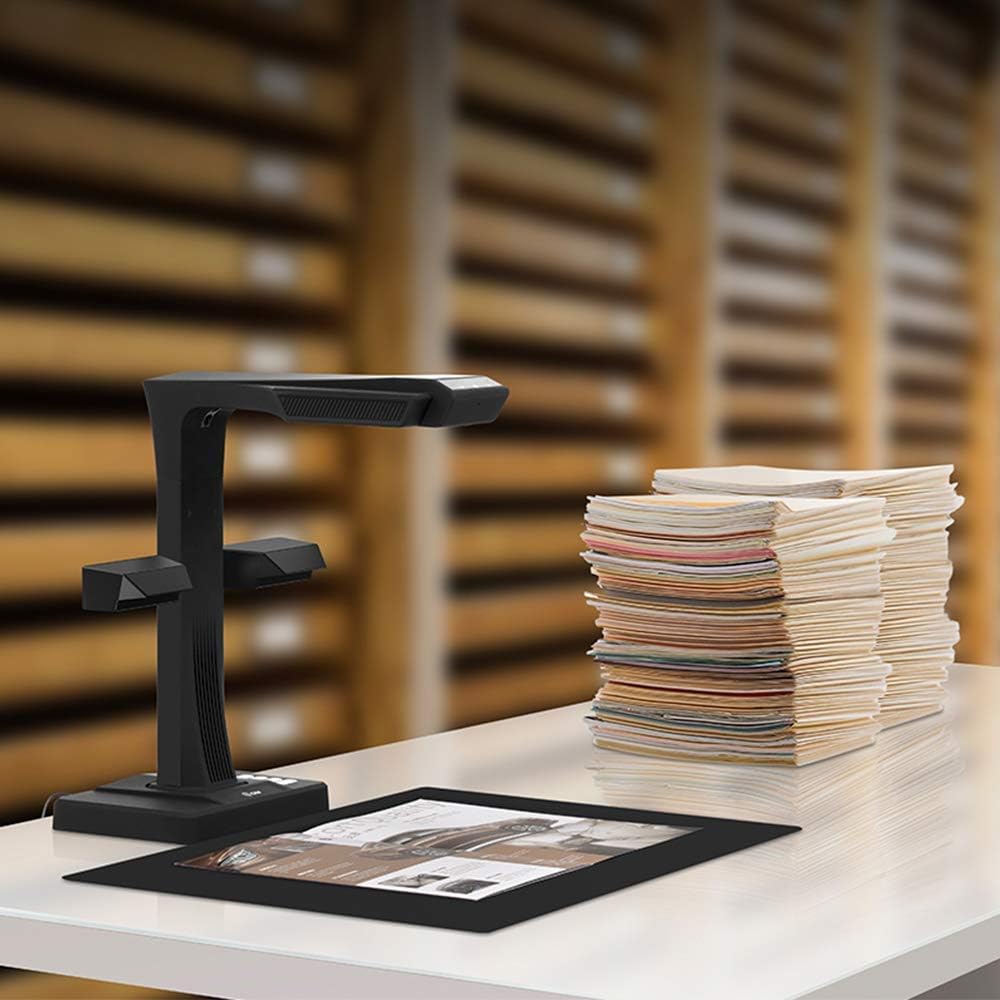
CZUR Professional Document Scanner ET18-P, Fast Recognition Scanner, 18MP High Definition, A3 Size Capture, 186 Languages OCR, Patented “Laser-Based Image Flattening” Technology : Electronics
- Category: Document Cameras
- Store: CZUR
Share on:
Description
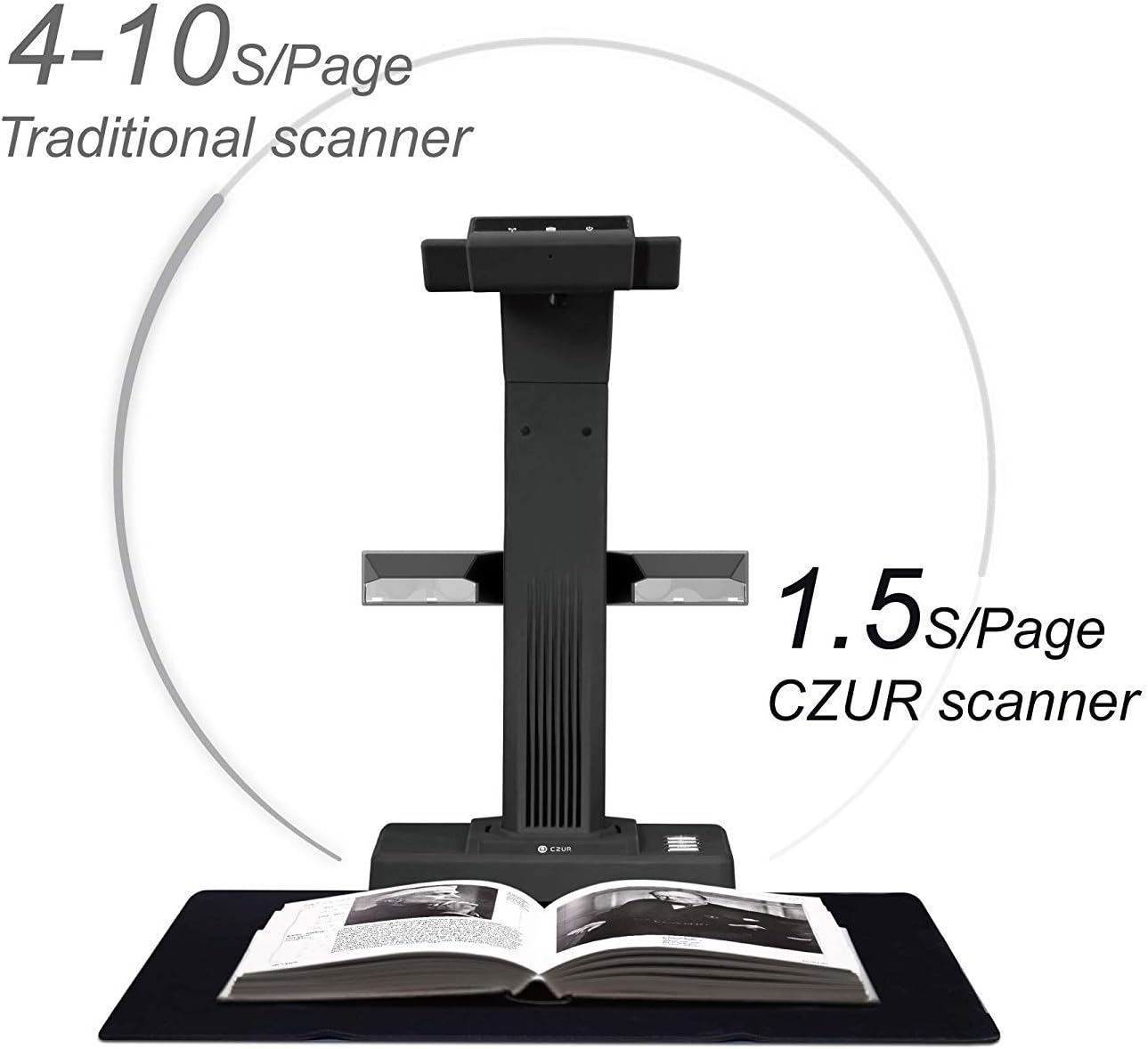
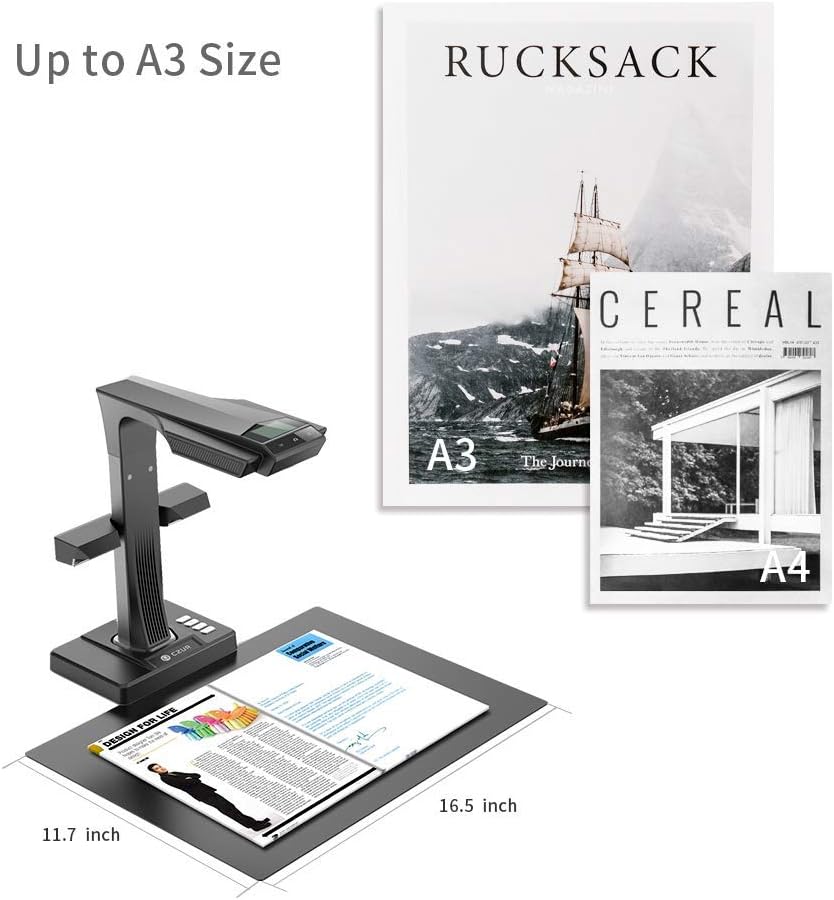
Introducing CZUR’s most advanced technology, “Laser-Based Image Flattening”, has been applied to the latest scanner product. A method of flattening a laser-based image of a curved book page is applicable to an image acquisition device and a laser generation device in a scanning platform or fixed at a scanning platform. The method comprises the following steps: opening a book on a horizontally arranged scanning platform, and emitting to a book page a laser beam, the laser beam forming a horizontal laser line on the curved book page; acquiring a flat image of the curved book page having thereon the horizontal laser line, and acquiring a 2D planar coordinate (x, y) of each pixel on the laser line in the flat image; computing, according a y-coordinate in the 2D planar coordinate, a y-coordinate of an intersection of the laser beam and the scanning platform, and an angle at the intersection of the laser beam and the scanning platform, and by means of a tangent function, a height of each pixel on the laser line, or an actual spatial height; computing actual spatial heights of all pixels on each laser line, or z coordinates, to obtain a 3D spatial curve of the laser line; constructing, using the curve, an actual 3D curved surface of the acquired book page; and flattening the 3D curved surface after pixel transformation to complete flattening of the book page. Benefited from powerful CPU, innovative overhead design and intelligent processing software, the CZUR ET18 makes scanning easy and quick by dispensing the tedious operation. To get a scanned file within 1.5 second by simply clicking a button. With non-contact scanning technique, the CZUR ET18 can scan fragile documents without any touching damage. Meanwhile CZUR ET18 makes scanning more commodiously with the foot pedal and TFT screen design. ·Curve Distortion Flattening & Fingerprints Erasing Laser-assisted flattening curve function is tailored to scan curved books. The three laser lines, integrated with smart algorithm, enable open pages to be digitized into well-flattened images, to form ebook easily while figerprints are automatically erased. ·One click OCR (Optical Character Recognition) Quickly transfer scanned imgaes into editable Word/PDF/TIFF or JPG files in one click via intelligent OCR function. OCR, comes from ABBYY, currently supports 187 languages. Equipped with 18-MegaPixel Sony HD camera, CZUR ET 18 provides high quality scanning results with up to A3 format coverage. Scanning artworks, test papers, children's homework can never be eaiser. High time to build your own digitial library and gallery. Outperforming any other existing scanners, CZUR not only scans contracts/financial instruments or cards, but also scans binding material like books, music, magazines or bound files without any extra damage. Also, it does well in scanning physical objects such as sculptures and packaging boxes. CZUR ET18 can be widely used in: 1. School/University/Library 2. Administration Department, Financial Department of Enterprises and Public Service Organizations 3. Law Office or Accounting Firm 4. Archives/Public Security Organization or court 5. Ancient books community Introducing CZUR’s Most Advanced Technology, “Laser-Based Image Flattening”, has been applied to our latest scanner product. A method of flattening a laser-based image of a curved book page is applicable to an image acquisition device and a laser generation device in a scanning platform or fixed at a scanning platform. The method comprises the following steps: opening a book on a horizontally arranged scanning platform, and emitting to a book page a laser beam, the laser beam forming a horizontal laser line on the curved book page; acquiring a flat image of the curved book page having thereon the horizontal laser line, and acquiring a 2D planar coordinate (x, y) of each pixel on the laser line in the flat image; computing, according a y-coordinate in the 2D planar coordinate, a y-coordinate of an intersection of the laser beam and the scanning platform, and an angle at the intersection of the laser beam and the scanning platform, and by means of a tangent function, a height of each pixel on the laser line, or an actual spatial height; computing actual spatial heights of all pixels on each laser line, or z coordinates, to obtain a 3D spatial curve of the laser line; constructing, using the curve, an actual 3D curved surface of the acquired book page; and flattening the 3D curved surface after pixel transformation to complete flattening of the book page.
Product Overview
We Recommend